ESG Integration is no longer a niche concept reserved for sustainability teams or ethical funds. It has become a core lens for decision-making for investors, boards, and consultants focused on risk, resilience, and long-term returns. Today, environmental, social, and governance factors are embedded directly into strategy, capital allocation, and performance evaluation.
For investors and advisory firms, ESG Integration is less about signaling values and more about improving judgment. It helps identify hidden risks, uncover operational inefficiencies, and assess how well an organization is positioned for regulatory pressure, market shifts, and stakeholder scrutiny. Firms that integrate ESG early tend to make more durable decisions and protect value over time.
What Is ESG Integration and Why It Matters Today
ESG Integration is the systematic inclusion of environmental, social, and governance factors into business strategy, investment analysis, and operational decision-making. Unlike standalone ESG reporting, integration means these factors actively influence choices rather than being tracked after the fact.
The shift matters because traditional financial analysis alone no longer captures a company’s full risk profile. Climate exposure, labor practices, governance quality, and supply-chain ethics can materially affect cash flows, cost of capital, and enterprise value. Investors increasingly recognize that ignoring these variables leads to blind spots.
For consultants, ESG Integration has become a strategic advisory discipline. Clients are no longer asking whether ESG matters. They are asking how to implement it in a way that is credible, measurable, and aligned with financial outcomes.
The Core Pillars of ESG Integration
Environmental Factors in ESG Integration
Environmental considerations focus on how a company interacts with natural systems. This includes climate risk, energy use, emissions, water management, and resource efficiency. From an investor perspective, these factors signal exposure to regulatory costs, operational disruption, and long-term sustainability of the business model.
Social Factors in ESG Integration
Social factors examine how a company manages relationships with employees, customers, suppliers, and communities. Labor standards, workplace safety, diversity, data privacy, and supply-chain responsibility all fall here. Weak social practices often translate into reputational damage, litigation risk, and talent loss.
Governance Factors in ESG Integration
Governance underpins how decisions are made and enforced. Board structure, executive incentives, transparency, compliance systems, and shareholder rights are critical. Strong governance reduces the risk of fraud, misallocation of capital, and strategic drift. For investors, governance quality is often the most reliable predictor of long-term performance.
How ESG Integration Creates Long-Term Business Value
ESG Integration creates value by improving risk management and strategic clarity. Companies that embed ESG considerations tend to anticipate regulatory changes earlier, avoid costly disruptions, and maintain stronger stakeholder trust. This translates into more stable earnings and lower volatility.
From an investment standpoint, ESG-integrated firms often demonstrate better capital discipline and resilience during market stress. They are also more likely to attract long-term institutional capital, which values predictability over short-term gains. For consultants, this makes ESG Integration a lever for both risk mitigation and performance enhancement.
ESG Integration in Investment Decision-Making
In investment analysis, ESG integration means evaluating ESG data alongside financial metrics rather than treating it as a separate screen. Asset managers use ESG insights to adjust forecasts, assess downside risk, and differentiate between companies with similar financial profiles.
Unlike negative screening, which excludes specific sectors, ESG integration is nuanced. It allows investors to identify industry leaders and laggards. This approach supports active ownership, engagement strategies, and more informed portfolio construction.
For advisory firms, helping clients operationalize ESG integration strengthens investment governance and aligns portfolios with long-term objectives.
For More Information: Corporate Sustainability Strategy
ESG Integration Frameworks and Standards to Know
Several frameworks guide ESG integration, each serving a different purpose. Commonly used standards include those focused on financial materiality, climate risk, and broader sustainability disclosures. While no single framework fits all, consistency and relevance matter more than volume.
Choosing the proper ESG Integration framework depends on industry exposure, regulatory environment, and data availability. Consultants play a key role in helping organizations avoid checkbox compliance and instead build a framework that informs real decisions.
Steps to Implement ESG Integration Successfully
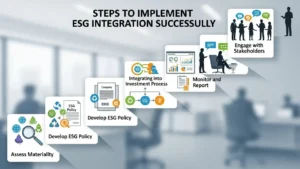
Effective ESG Integration follows a structured approach. First, organizations assess ESG risks and opportunities that are financially material to their operations or investments. This requires mapping ESG issues to revenue drivers, cost structures, and risk exposure.
Next, clear ESG objectives are defined and embedded into strategy, governance, and incentives. ESG considerations should influence capital allocation, supplier selection, and executive decision-making. Measurement follows, using relevant metrics rather than generic scores.
Finally, performance is monitored, disclosed transparently, and refined over time. ESG integration is not a one-off project. It is an ongoing management discipline that evolves with data quality and regulatory expectations.
Common Challenges in ESG Integration and How to Address Them
One major challenge is inconsistent or incomplete ESG data. This can be mitigated by focusing on material issues and improving internal data governance over time. Another issue is the lack of internal alignment, where ESG is siloed away from the core strategy. Strong board oversight and executive ownership help bridge this gap.
Greenwashing concerns also pose reputational risks. The solution lies in aligning claims with measurable actions and outcomes. Consultants add value here by establishing credible processes and controls that withstand scrutiny.
ESG Integration vs ESG Reporting: Key Differences
ESG reporting focuses on disclosure, while ESG integration focuses on decision-making. Reporting looks backward, documenting what has happened. Integration looks forward, shaping strategy and investment choices.
For investors and consultants, reporting without integration offers limited insight. Integration without transparent reporting lacks credibility. The most effective approach treats reporting as an outcome of integration, not a substitute for it.
The Future of ESG Integration
The future of ESG Integration points toward deeper regulatory alignment, improved data analytics, and greater investor expectations. As ESG factors become standardized, integration will move from a differentiator to a baseline requirement.
Advisory firms that build strong ESG integration capabilities now will be better positioned to guide clients through this transition. For investors, integration will increasingly define fiduciary responsibility rather than optional strategy.
FAQs About ESG Integration
What does ESG Integration mean?
ESG Integration means incorporating environmental, social, and governance factors into strategic, financial, and investment decisions rather than treating them as separate considerations.
How is ESG Integration used in investing?
Investors use ESG Integration to assess risks, adjust valuations, and identify companies with stronger long-term prospects within the same sector.
Is ESG Integration mandatory?
While not universally mandatory, regulatory and investor pressure are making ESG Integration increasingly expected, especially for institutional investors.
What is the difference between ESG and sustainability?
Sustainability is a broader concept. ESG Integration focuses specifically on factors that are measurable and relevant to financial and strategic outcomes.
Does ESG Integration improve financial performance?
Evidence suggests that effective ESG Integration can reduce risk and improve long-term performance, particularly during periods of market stress.
Final Thoughts
ESG Integration has moved beyond trends and terminology. For investors and consultants, it is now a core competency that shapes how value is protected and grown over time. Organizations that embed ESG into real decisions are better equipped to navigate uncertainty, regulation, and stakeholder expectations. Those who delay risk being caught reactive rather than prepared.